
Most homeowners in Rapid City hire a roofer once every fifteen to thirty years. The people who do this for a living know that. After every major hail event in the Black Hills, out-of-state contractors flood the area hoping you can’t tell the difference between a legitimate local pro and someone who’ll be three states away by the time your shingles start lifting.
This guide gives you a vetting framework before you sign anything. South Dakota licensing checks, manufacturer certifications, the questions to ask, the red flags that should end the conversation, and the warranty terms that actually mean something fifteen years from now. The goal is simple: at the end of this article you should know exactly what to look for, what to ask, and how to spot the contractor who’ll still be picking up the phone in 2036.
K1 Roofing Inc. has installed and replaced roofs in Rapid City and the surrounding Black Hills for over 30 years. The criteria below reflect what actually separates a legitimate Rapid City contractor from a one-storm operator, not a generic national checklist.
Step 1: Verify the Roofer Is Actually Licensed in South Dakota
Before anything else, confirm the contractor is legally allowed to do the work in South Dakota.
South Dakota does not have a single statewide residential roofing license, but the South Dakota Department of Labor and Regulation does require general contractor registration and specific licensing for electrical, plumbing, and HVAC work that often touches a roof job. Pennington County and the City of Rapid City both require contractors to be registered with the city and to pull a building permit on most replacement-scale jobs. A legitimate roofer will give you the permit number on request and will not ask you to pull the permit yourself.
What to verify:
- The contractor has a permanent South Dakota business address, not a temporary post-storm office.
- They carry general liability insurance and workers’ compensation. Ask for current certificate-of-insurance documents and confirm the policy is active by calling the carrier listed on the certificate.
- They will pull the permit and put their name on it. If a contractor asks you to pull the permit “to save money,” that is a red flag that they are unlicensed or trying to avoid inspection liability.
Storm chasers consistently fail this step. Most operate without a South Dakota address, use rented PO boxes, or refuse to provide insurance documentation. If you can’t verify a contractor’s license, insurance, and local registration within fifteen minutes of asking, do not sign with them.
Step 2: Check Manufacturer Certifications
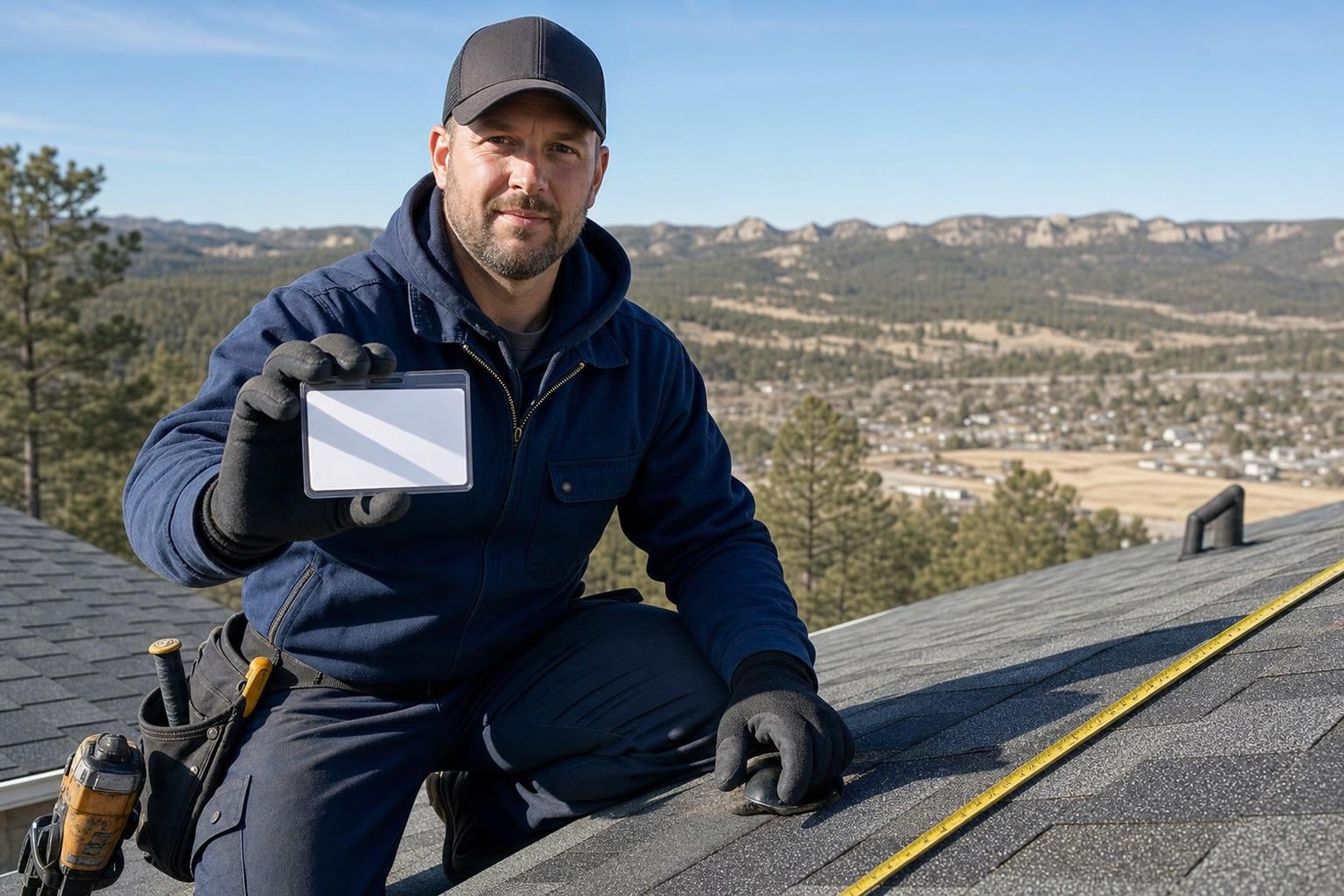
A manufacturer certification is the closest thing to an objective quality filter in residential roofing. The three major asphalt-shingle manufacturers (CertainTeed, GAF, and Owens Corning) each operate a certification program that requires participating contractors to meet training, insurance, warranty, and customer-satisfaction standards before they can install certified-tier warranties.
The programs to recognize:
- CertainTeed ShingleMaster: requires advanced installer training, full liability and workers’ comp insurance, ongoing education, and a clean customer-complaint history. ShingleMaster contractors can offer the CertainTeed SureStart Plus warranty, an extended manufacturer-backed warranty unavailable through non-certified contractors.
- GAF Master Elite: caps participation at roughly 2 percent of US roofers per region. Master Elite contractors can install the GAF Golden Pledge warranty, which covers material and workmanship.
- Owens Corning Platinum Preferred: similar quality tier; required for the Platinum Protection limited warranty.
These certifications are public. CertainTeed, GAF, and Owens Corning all publish searchable contractor directories on their websites. Type any roofer’s name into the appropriate directory before you sign. If they claim a certification that doesn’t show in the directory, walk away.
K1 Roofing is CertainTeed ShingleMaster certified, which qualifies K1 homeowners for the extended SureStart Plus warranty.
Step 3: Understand the 25% Rule and Why It Matters
The “25% rule” comes up in roofing conversations and most homeowners have never heard of it.
In broad terms, the 25% rule is the building-code threshold where a roof crosses from “repair” territory into “replacement” territory. Most jurisdictions that follow the International Residential Code require that if more than 25 percent of a roof’s surface is being replaced or repaired within a 12-month window, the entire roof must be brought up to current code, which typically means a full replacement rather than a patched repair.
This matters when you’re hiring because:
- A contractor who recommends repair when damage is clearly above the 25% threshold is either inexperienced or cutting corners. Code requires the full job.
- A contractor who tries to slip repair work past the threshold to undercut competitors on price is exposing you to an inspection failure and, more importantly, a denied insurance claim if the roof fails later.
- Knowing about the rule changes how you read estimates. If two bids look similar but one quotes “repair” and one quotes “replace,” ask each contractor to walk you through the 25% math on your specific roof.
Ask the contractor directly: “Based on what you saw, what percentage of the roof surface is involved, and does that put us above or below the 25% threshold?” The answer separates contractors who know roofing code from contractors who memorized a sales script.
Step 4: Insurance and Storm Damage Cooperation
A roofer who only knows shingles is worth less in Rapid City than a roofer who knows insurance.
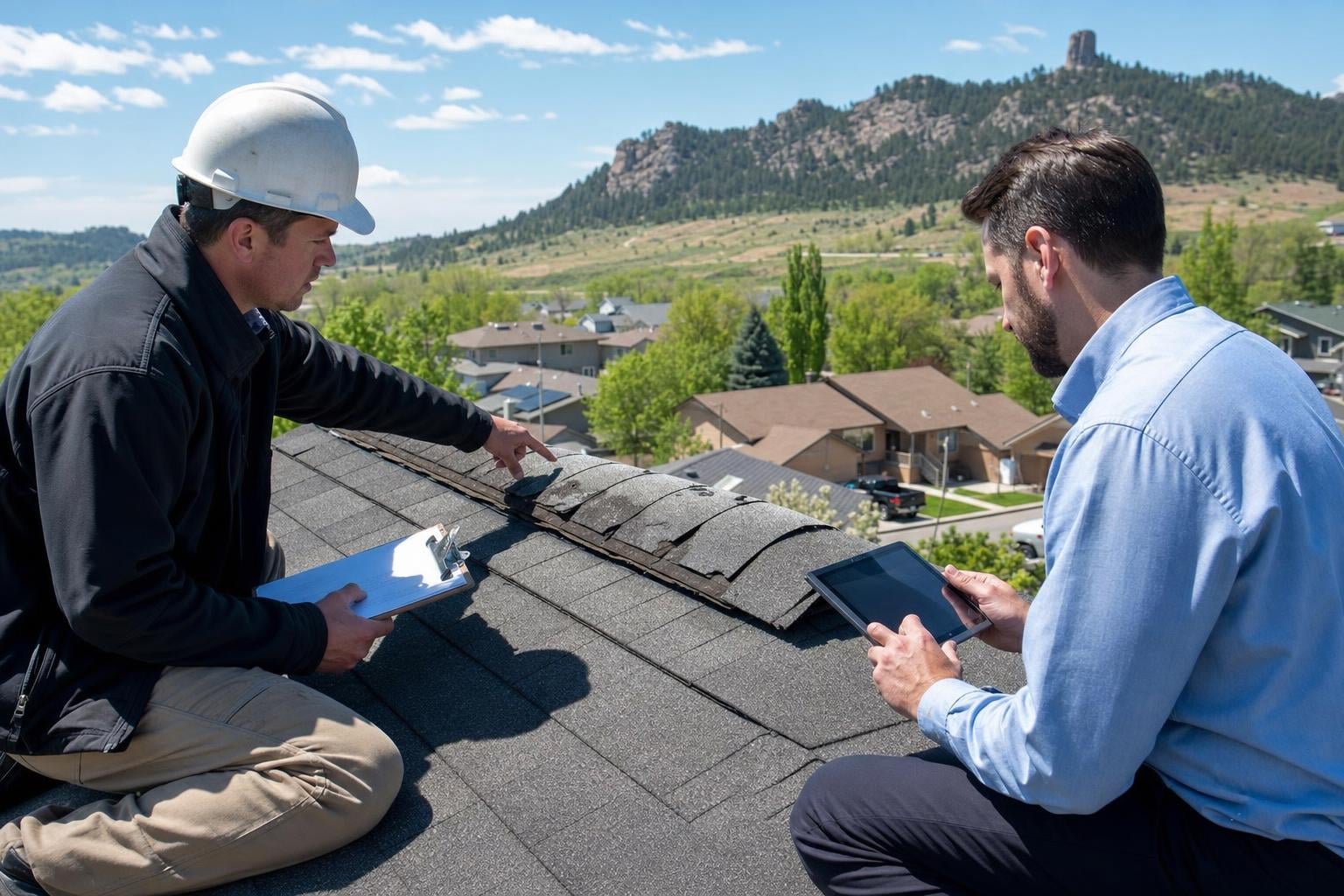
After every hail event, homeowners file thousands of claims across South Dakota. The contractors who consistently produce complete claim outcomes are the ones who attend the insurance adjuster meeting, understand Xactimate estimating software, and can submit supplemental claims for items the adjuster’s initial scope missed. A roofer who hands you a bid and tells you to “figure out the insurance side” is leaving money on the table for both of you.
What to look for:
- The contractor will attend the adjuster meeting at no charge.
- They can explain Actual Cash Value (ACV) vs. Replacement Cost Value (RCV) in plain language and walk you through the two-check payout system.
- They have submitted supplemental claims before and can describe specific examples (pipe jacks, drip edge, ridge cap, overhead and profit) without prompting.
- They will not offer to “waive” or “absorb” your deductible. That practice is insurance fraud in South Dakota.
For a complete walkthrough of the claim process from documentation through depreciation release, see our hail damage claim guide.
Step 5: Red Flags That Should End the Conversation
The contractors most likely to cost you money are the ones who show up first. Specific behaviors to refuse:
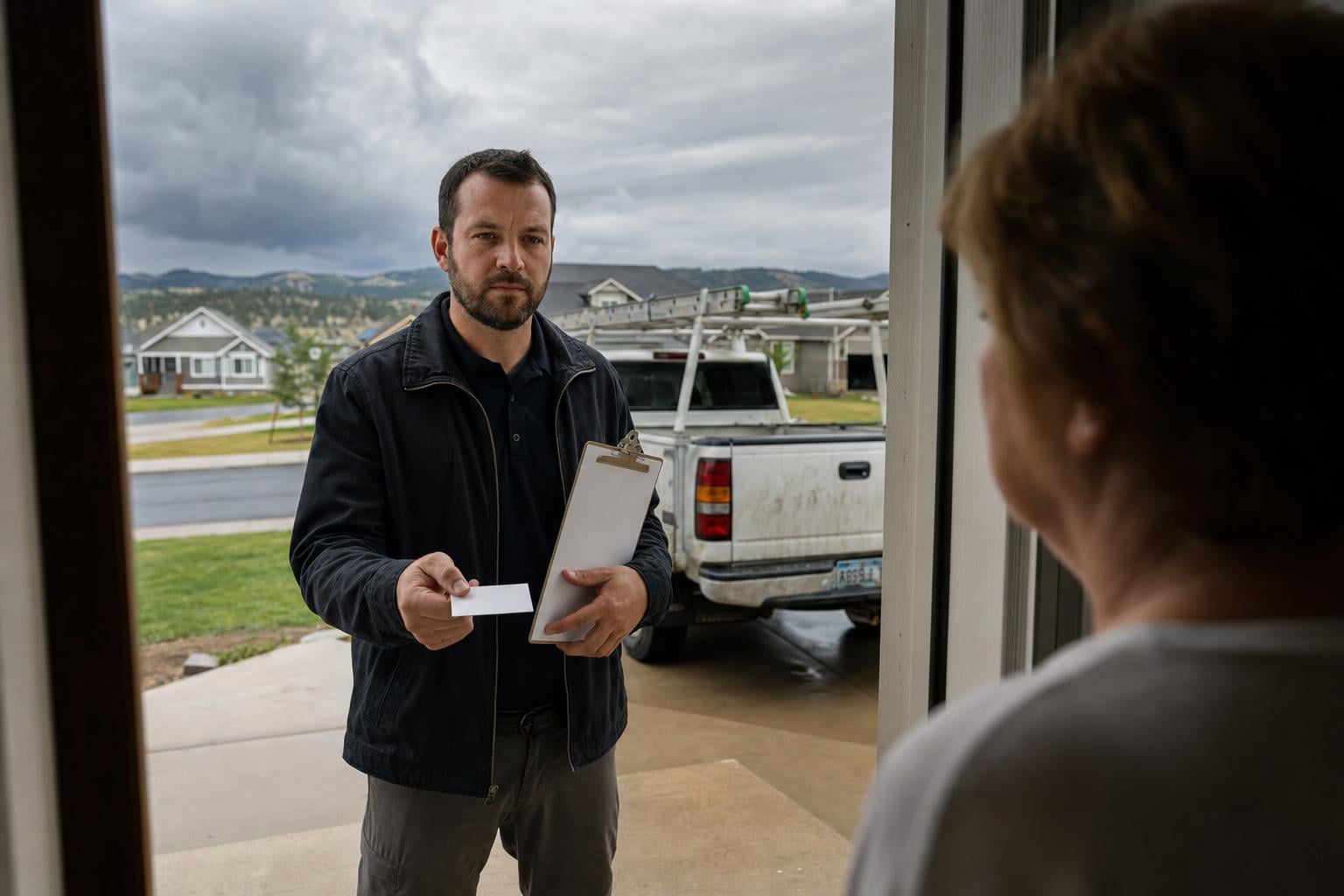
- Door-knock pressure within 24 to 48 hours of a storm. Legitimate local contractors do not need to canvas neighborhoods. They have a phone that rings.
- Refusal to provide a South Dakota contractor license number or insurance certificate. Both should be available on request, immediately.
- Offers to waive your deductible. South Dakota classifies this as insurance fraud. It voids your coverage and exposes you to legal liability.
- Assignment of Benefits (AOB) requests. An AOB transfers your insurance-claim rights directly to the contractor. Once signed, you lose control of the claim and the contractor can negotiate (or settle) without your input.
- Pressure to sign immediately, before insurance has inspected. A reputable contractor will document damage, give you a written inspection report, and wait for your insurance adjuster.
- No verifiable Rapid City history. Search the company name plus “Rapid City” on Google, BBB, and Facebook. A contractor with no Rapid City reviews older than 18 months is a contractor who arrived after the last storm.
- Out-of-state plates on the work trucks, no local office, materials from unfamiliar suppliers. All three together are the storm-chaser signature.
When the contractors who arrived for the storm leave town, the warranty leaves with them. Pick a contractor who’ll be in Rapid City when something goes wrong.
Step 6: Questions to Ask Before You Sign
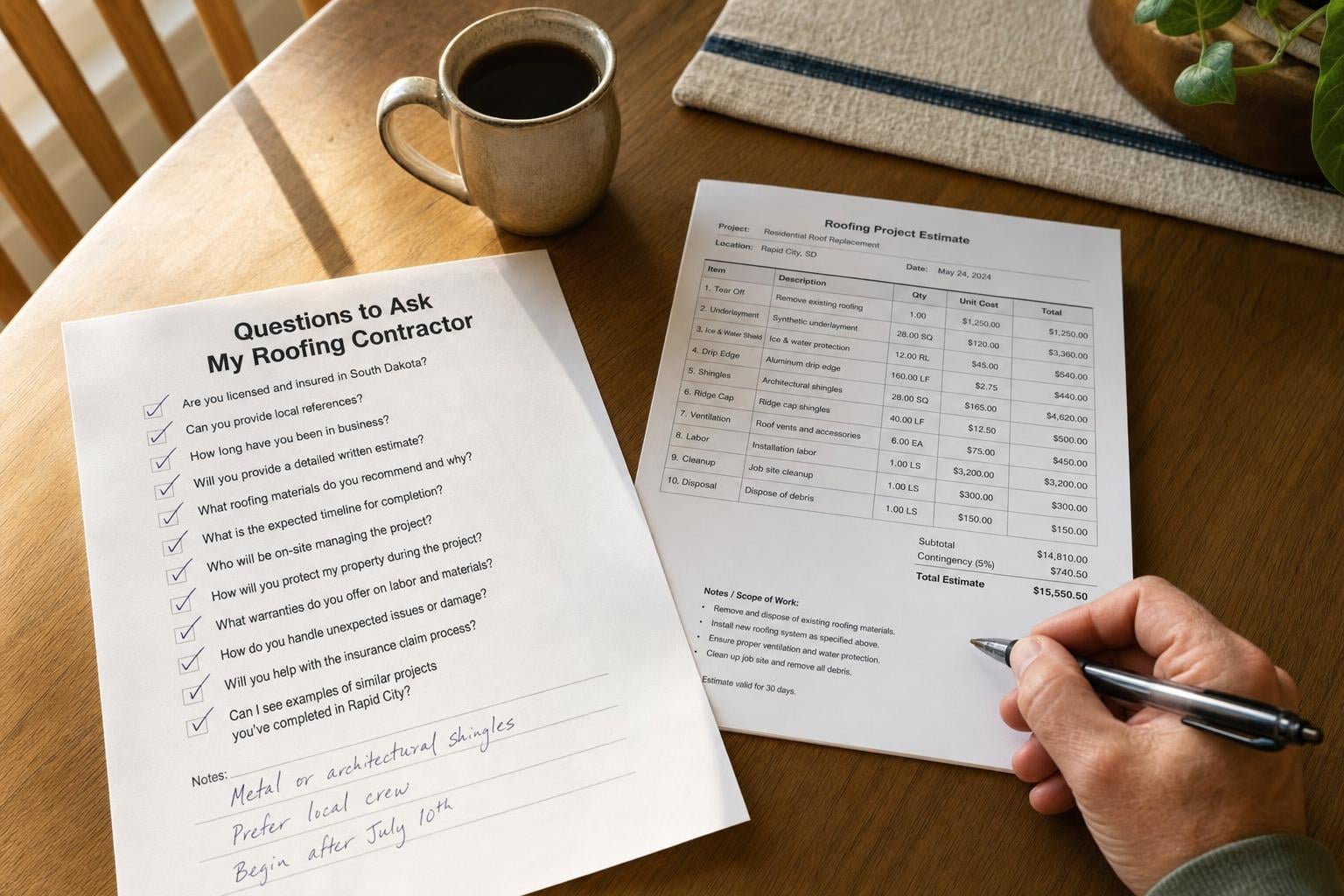
Use these in order. A contractor who can’t answer the first three doesn’t make it to the fourth.
- What is your South Dakota contractor license or registration number, and can I look it up?
- Are you certified by a major manufacturer (CertainTeed, GAF, Owens Corning), and can I verify that in the manufacturer’s directory?
- Can I see your current general liability and workers’ compensation certificates of insurance?
- Will you attend the insurance adjuster meeting, and do you submit supplemental claims when adjusters miss line items?
- Will you pull the building permit in your name?
- What’s the workmanship warranty (years and what it covers), and is the material warranty manufacturer-backed?
- Do you offer Class 4 impact-resistant shingles, and what’s the cost difference vs. standard?
- Who’s the crew? Are they on staff, or are you subbing the work out?
- What’s your tear-off policy: single-layer, multi-layer, and what about decking?
- Will you replace pipe jacks, drip edge, and ridge cap with new materials, or reuse them?
- What’s your timeline, and what’s the daily start and finish window?
- Can I see three references in Rapid City from jobs over five years old?
Question 12 is the one most homeowners skip. Anyone can pull a list of last-summer references. The roof you’re buying needs to last twenty to thirty years. The contractors who give you a five-year-old reference list with current phone numbers are the ones whose work holds up.
Step 7: Reviews, References, and Portfolio
Online reviews are useful as a volume signal, not as proof of quality. What to actually look at:
- Volume and consistency over time. A contractor with 200 reviews accumulated steadily over 10 years is a very different operation from one with 200 reviews from the past 4 months.
- Pattern of complaints. Read the negative reviews first. A few one-star reviews are normal for any contractor at scale. What matters is whether the same complaint shows up repeatedly (no-show, billing surprises, warranty claims ignored).
- BBB profile. Check the Better Business Bureau for Rapid City. Look at complaint resolution patterns and how long the business has been BBB-accredited.
- Drive-by portfolio. Ask for three Rapid City addresses where the contractor has done work in the last 12 months. You can drive past and look. A contractor who can’t (or won’t) provide local addresses is a contractor without a local portfolio.
- Old references. Per question 12 above, references from five-year-old jobs are the real warranty test. New roofs all look good for the first year.
Step 8: Warranty Terms That Actually Mean Something
Roofing warranties confuse most homeowners because they’re really two separate warranties bundled into one conversation.
Workmanship warranty. Covers installation defects. Provided by the contractor. Lasts as long as the contractor stays in business. A 25-year workmanship warranty from a contractor who has been operating for two years is worth two years, period. Length is meaningless without longevity.
Material warranty. Covers the shingles and components themselves. Provided by the manufacturer. Usually 25 to 50 years depending on shingle line. Manufacturer warranties survive contractor failure.
Extended manufacturer warranties. Available only through certified contractors. CertainTeed’s SureStart Plus, GAF’s Golden Pledge, and Owens Corning’s Platinum Protection all extend coverage to include workmanship issues backed by the manufacturer, not just the contractor. These are the warranties worth optimizing for, because they survive even if the installing contractor is no longer in business when an issue surfaces.
K1 Roofing’s ShingleMaster certification qualifies K1 customers for the CertainTeed SureStart Plus extended warranty.
When comparing bids, ask each contractor to spell out which warranty they’re quoting. A “lifetime warranty” from an in-house workmanship guarantee is not the same as a manufacturer-backed extended warranty, and the difference can be tens of thousands of dollars in coverage twenty years from now.
Step 9: Best Time of Year to Schedule Roofing in Rapid City
The cheapest time to replace a roof in Rapid City is October through early November, in most years.
Spring is the busiest season for hail-claim replacements. Summer is hail-emergency season, when contractors run wait lists and pricing reflects demand. Late fall sits in a sweet spot: insurance claim work has wound down, weather is still workable, and most reputable contractors have crew capacity. December through March is technically off-season, but snow and frozen decking can push installation windows out and create scheduling unpredictability.
The National Roofing Contractors Association notes that asphalt shingle installation performs best at temperatures between 45 and 85 degrees Fahrenheit. Self-sealing strips on shingles need warmth to bond properly. In the Black Hills, that puts the prime install window roughly mid-April through mid-November, with the pricing advantage skewed to the back half of that range.
If your roof can wait, schedule the consultation in August and the install in October. If your roof can’t wait (active leak, recent storm damage), the priority is getting it installed correctly, not getting the seasonal discount.
Step 10: Why Local Matters in Rapid City Specifically
A national contractor with a Rapid City satellite office is not the same as a Rapid City contractor.
Local matters specifically because:
- Weather knowledge. Black Hills weather has specific patterns (hail-heavy summers, dry-cold winters, microbursts off the foothills) that affect material selection and installation timing. Contractors who have worked here for a decade know what fails in this climate and what doesn’t.
- Local ordinances. Rapid City and Pennington County have specific building-code expectations around drip edge, ice-and-water shield placement, and ventilation that vary from national norms. A contractor who works statewide may not catch a local code item that triggers an inspection failure.
- Supplier relationships. Local contractors have material accounts with Black Hills suppliers, which matters when a shingle line is back-ordered or when an unusual component is needed mid-job.
- Warranty service. A workmanship issue ten years from now needs a contractor who’s still in Rapid City. National outfits restructure; local contractors with deep roots are still answering the phone.
K1 Roofing has operated continuously in Rapid City for over 30 years, with a local crew and a Rapid City office.
Step 11: How K1 Roofing Stacks Up Against the Criteria
Self-applying the criteria above is the most useful thing K1 can do for a homeowner who has just read this guide.
- South Dakota licensed and locally registered. Yes, in Rapid City and Pennington County.
- Insurance. General liability and workers’ comp current, certificates available on request.
- Manufacturer certification. CertainTeed ShingleMaster, verifiable in the CertainTeed contractor directory.
- Extended warranty access. CertainTeed SureStart Plus available to K1 customers.
- Insurance cooperation. K1 attends adjuster meetings, prepares independent inspection reports, and submits supplemental claims when adjusters miss line items.
- Class 4 impact-resistant options. Available, with CertainTeed lines that qualify for the SureStart Plus extended warranty.
- Local crew. On staff. K1 does not sub the roofing work out.
- Years in Rapid City. Over 30, continuous.
- Free written inspection. Provided at no cost or obligation.
If you want to compare those criteria against the bid you’re holding, the FAQ at the bottom of this guide cross-references current 2026 material and labor ranges in Rapid City.
The Right Contractor Outlasts the Storm
The roof on your house should outlast the contractor who installed it. That sounds obvious until you realize how many contractors in Rapid City won’t be here in five years.
The framework here is simple to apply, even if it takes an afternoon to work through: verify the license, verify the certification, read the warranty, ask the twelve questions, look at the five-year references, and walk past a few of the contractor’s recent local jobs. Skip any of those and you’re picking on price or instinct. Run the full filter and you’ll narrow the field to one or two contractors very quickly.
K1 Roofing offers free written inspections for Rapid City homeowners with no obligation. The inspection itself is useful even if you choose another contractor: a documented, independent assessment of your roof’s condition gives you a baseline for any conversation that follows. Contact K1 to schedule one before the next storm makes the decision urgent.
Frequently Asked Questions
What is the 25% rule in roofing? The 25% rule is a building-code threshold (referenced in the International Residential Code and adopted by most jurisdictions including South Dakota) that says if more than 25 percent of a roof’s surface is being replaced or repaired within a 12-month window, the full roof must be brought up to current code. In practice that means a full replacement, not a patched repair. Ask any contractor what percentage of your roof is involved; if the answer is “more than 25 percent” the right recommendation is replacement.
How do you pick a good roofer in Rapid City? Verify South Dakota licensing and city registration, confirm general liability and workers’ compensation insurance, check for a major manufacturer certification (CertainTeed ShingleMaster, GAF Master Elite, or Owens Corning Platinum Preferred), ask for three Rapid City references from jobs over five years old, and confirm the contractor will attend the insurance adjuster meeting if storm damage is involved. The contractors who satisfy all five filters are the contractors worth quoting.
What is the cheapest time of year to get a new roof in Rapid City? October through early November is typically the best pricing window in the Black Hills. Spring is hail-claim season and summer is emergency-repair season; both push pricing up. Late fall has crew capacity, workable weather, and lower demand. Avoid mid-December through March if you can: cold-weather installation is technically possible but creates scheduling unpredictability and can affect shingle sealing.
How much do shingles cost for a 1,200 square foot roof in Rapid City? A 1,200 square foot home in Rapid City typically runs $6,500 to $9,000 for an architectural asphalt replacement in 2026 pricing, depending on roof complexity, pitch, and material upgrade choices. For the full cost breakdown by home size and material type, see the Rapid City roof replacement cost guide.
Does South Dakota require roofing contractors to be licensed? South Dakota does not issue a statewide roofing-specific license, but most jurisdictions (including Rapid City and Pennington County) require general contractor registration, building permits for replacement-scale work, and proof of current general liability and workers’ compensation insurance. Contractors who can’t produce city registration documents or current insurance certificates are not legally clear to do the work.
![Roof Maintenance Checklist for Rapid City, SD: The Year-Round Homeowner’s Guide [2026]](https://www.k1roofinginc.com/wp-content/uploads/2026/05/k1-roofing-inc-roof-maintenance-rapid-city-sd-featured-400x250.jpeg)
![Commercial Roof Replacement in Rapid City, SD: The Complete Guide for Building Owners [2026]](https://www.k1roofinginc.com/wp-content/uploads/2026/05/k1-roofing-inc-commercial-roof-replacement-rapid-city-sd-featured-400x250.jpeg)
0 Comments