
Rapid City roofs work harder than most. Between 222+ historical hail events tracked by Doppler radar, the high-altitude UV exposure of the Black Hills, the temperature swings from below zero in January to mid-90s in July, and the wind events that move through the foothills, the average residential asphalt roof here ages faster than the manufacturer’s nominal lifespan suggests.
The question most Rapid City homeowners eventually ask is “do I actually need a new roof, or do I just need a repair?” The answer is rarely obvious from the ground. This guide gives you 10 specific, observable signs to look for, with the local context that affects each one. Some are storm-driven, some are age-driven, and some only show up from the attic.
By the end you’ll know which signs are serious, which are repairable, and which combinations should trigger a written inspection from a local contractor.
K1 Roofing Inc. has been performing roof inspections in Rapid City for over 30 years. The signs below reflect what we actually look for on a typical inspection, not a generic national checklist.
Sign #1: Your Roof Is Over 20 Years Old
Age alone doesn’t mean replacement, but it changes the math on every other sign in this list.
Asphalt roofing has predictable lifespan ranges. Standard 3-tab shingles typically last 15 to 20 years. Architectural (also called dimensional) shingles last 20 to 30 years. Class 4 impact-resistant asphalt in a hail-prone market like Rapid City lasts 25 to 35 years. Metal roofing runs 40 to 70 years depending on type. Lifespan ranges come from manufacturer specifications and National Roofing Contractors Association field data.
A 20-year-old standard asphalt roof in Rapid City has likely seen 8 to 12 measurable hail events. Each event compresses the remaining service life, even if no individual event triggered a replacement-grade claim. By year 20, even an unremarkable-looking roof has accumulated UV degradation, granule loss, and micro-fractures.
The age threshold isn’t a death sentence. We’ve inspected 22-year-old roofs in Rapid City that had three more usable years left. We’ve also inspected 12-year-old roofs that needed full replacement due to one bad hail event. Age is one input among many.
If your roof is approaching or past the bottom of its lifespan range, the other nine signs below carry more weight. Pull your closing documents or HOA records to confirm the year of last replacement if you’re not sure.
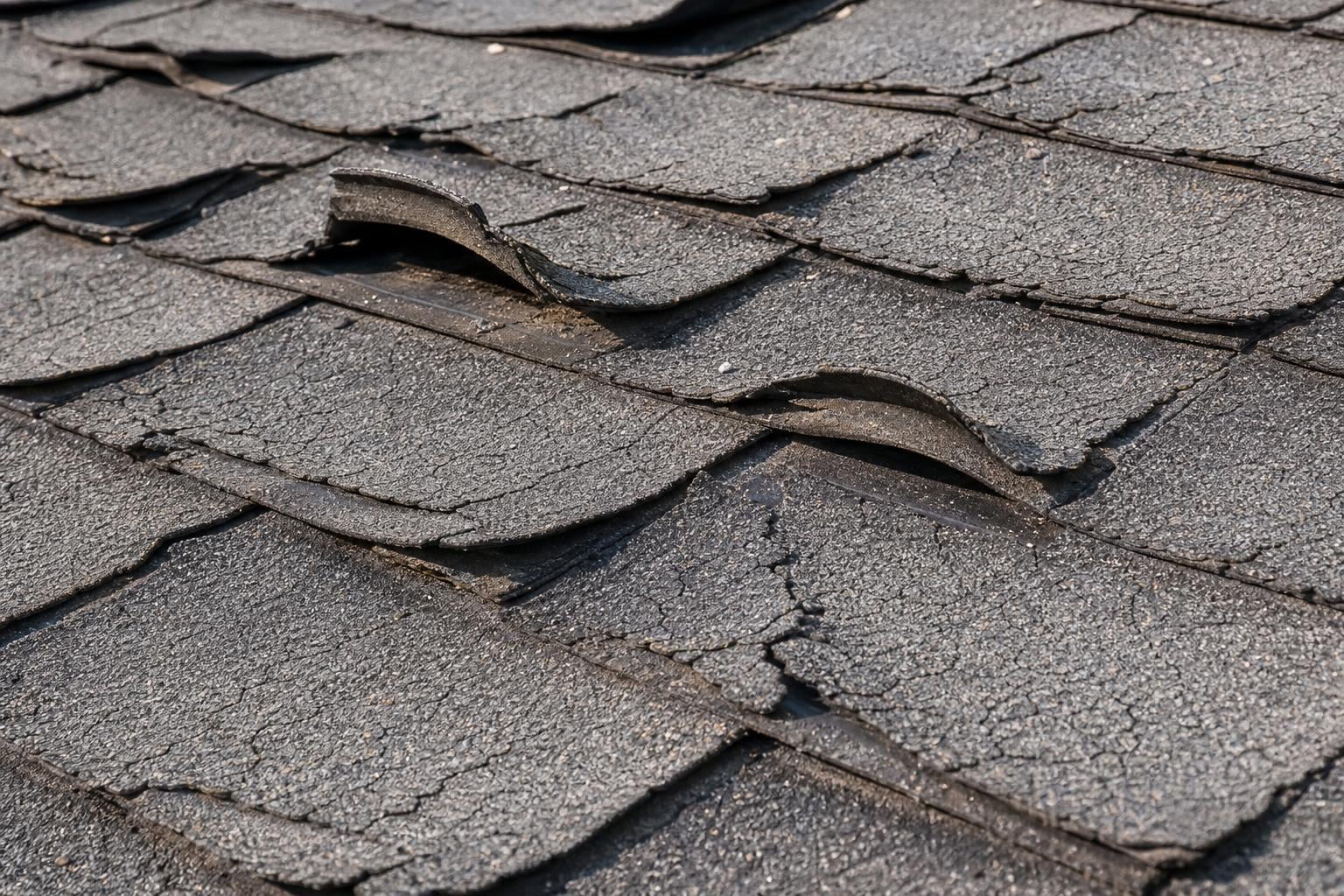
Sign #2: Curled, Cupped, or Cracked Shingles
This is the most visible age-driven failure mode and you can spot it from the ground with binoculars.
Curling shingles have edges that have lifted up off the surface below, often showing the asphalt mat underneath. Cupping is when the shingle bows in the center, creating a slight saucer shape. Cracking is straight or branching fractures across the field of the shingle, usually starting at the tab.
The underlying causes are UV degradation, thermal cycling, and ventilation failure. Asphalt shingles expand in summer heat and contract in winter cold. After 15 to 20 years, the binders that hold the shingle together lose elasticity and the shape changes become permanent. In Rapid City’s freeze-thaw climate, this acceleration is faster than the national average.
The decision between repair and replacement comes down to coverage. A few curled shingles in one area (less than 10% of the field) can be repaired. When curling, cupping, or cracking covers 20% or more of the roof, you’ve crossed into replacement territory. At that scope, code in most jurisdictions including Pennington County requires the full roof to be brought up to current standards rather than patched.
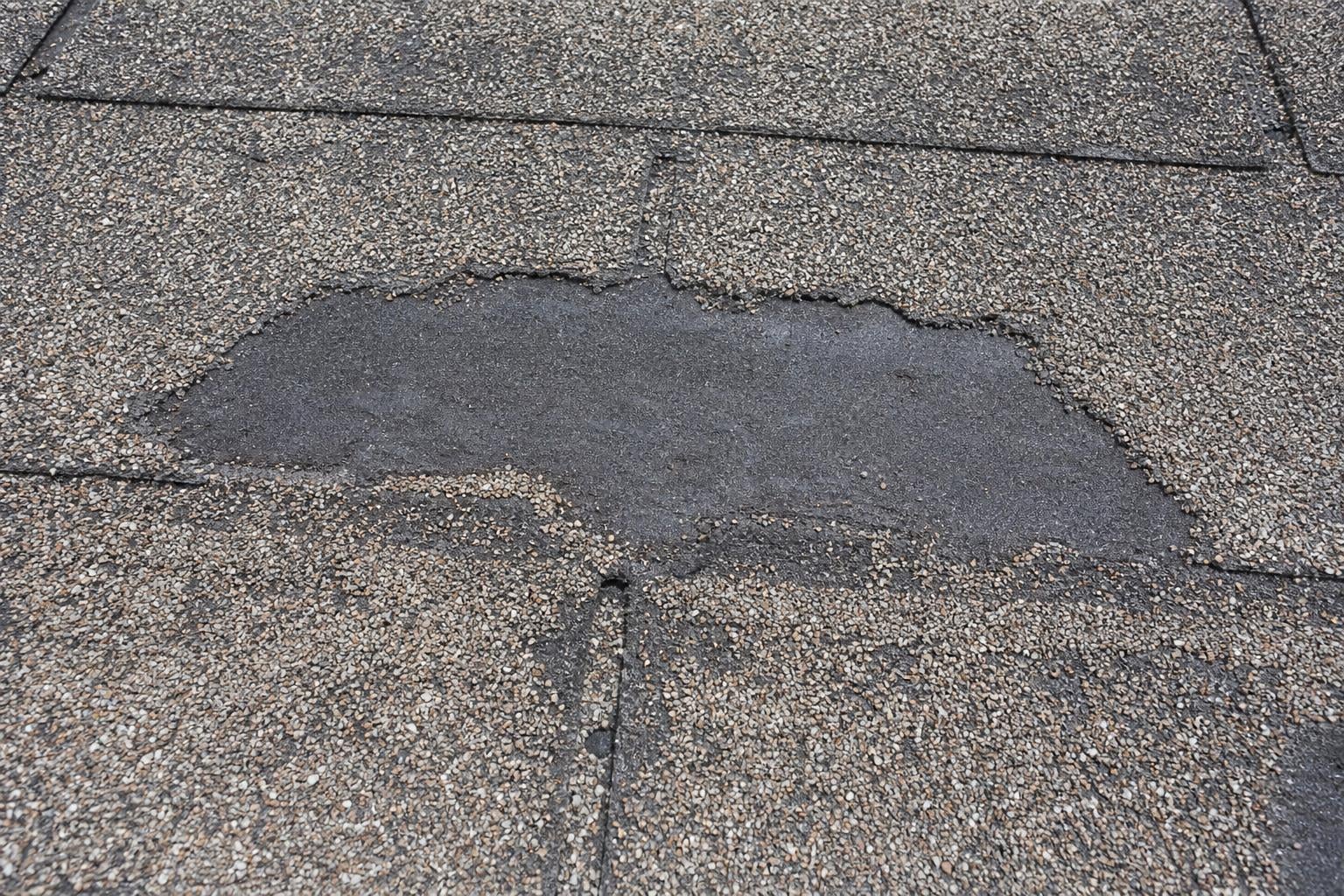
Sign #3: Granule Loss
The colored granules on an asphalt shingle aren’t just for color. They protect the asphalt mat underneath from UV degradation. When granules go, the underlying mat starts to fail within a few years.
Check three places for granule loss:
- The gutters. Heavy granule accumulation in gutters and downspouts after a storm is normal in the first 5 years (manufacturers expect some loss-on-install). After year 10, sustained granule accumulation signals active shedding.
- The roof field itself. Look from the ground or from windows. Bare patches where the gray-black asphalt mat shows through, especially on south-facing slopes that get the most UV, are advanced granule loss.
- The downspout splash zones. Concentrated piles of granules at the base of downspouts.
Distinguish age-driven from storm-driven granule loss. Age-driven appears gradually, distributed across the whole roof. Storm-driven appears suddenly after a hail event, often concentrated in impact zones and accompanied by visible impact marks. Storm-driven granule loss is typically covered by hail insurance claims; age-driven is not.
Once granule loss reaches a tipping point (visible bare mat across 15% or more of the field), the remaining shingle lifespan drops to a fraction of the rated number.
Sign #4: Missing or Damaged Shingles
A few missing shingles after a windstorm are a repair, not a replacement. A pattern of missing or damaged shingles signals a system failure.
Look for:
- Tabs that have lifted or torn off, exposing the underlayment or decking below.
- Shingles with visible impact damage (denting, cracking, granule-loss craters from hail).
- Random missing shingles in multiple areas, not concentrated in one wind-exposed corner.
If you see one or two missing tabs in one area, call a contractor for a localized repair. If you see missing or damaged shingles in 5 or more locations, or if the damage spans more than one slope, you’re looking at either a major storm event (insurance claim territory) or a roof that’s reached the end of its serviceable life.
The repair-versus-replace threshold also depends on the age of the roof. Replacing a few shingles on a 5-year-old roof is straightforward. Replacing a few shingles on a 22-year-old roof is harder because manufacturer color matches change over decades, the surrounding field has weathered, and the repair will be visible.
Sign #5: Sagging Roof Deck
A roof that no longer holds a straight line along the ridge or eaves is a structural problem, not a cosmetic one.
Stand back from the house, get a low-angle view, and sight along the ridge. The line should be straight from gable to gable. Any visible bow, sag, or dip indicates that something underneath has failed.
Common causes:
- Water damage to the decking (most common). Persistent moisture has rotted the sheathing under the shingles.
- Truss or rafter failure. Less common but more serious; the structural members supporting the roof have cracked, separated, or settled.
- Excessive load from snow, ice damming, or rooftop equipment.
This is one of the few signs on this list that requires immediate professional attention. A sagging roof can progress quickly to localized collapse, especially after a heavy snowfall. If you see sag, do not climb on the roof, and schedule an inspection within days, not weeks.
A sagging roof always requires replacement of the affected decking and often the affected structural members, not just new shingles. Budget accordingly.
Sign #6: Daylight Through the Attic Roof Boards
This is the easiest interior inspection on the list and it tells you a lot.
On a sunny day, go into the attic and turn off the lights. Let your eyes adjust for 30 seconds. Then look up at the underside of the roof decking.
What you should see: a uniformly dark surface with no light coming through, except possibly around vents, the attic ladder, and the attic fan.
What you should not see:
- Pinpoint stars of light along the roof field.
- Light streaks at the seams between decking sheets.
- Bright spots at flashing locations (around vents, chimneys, valleys).
- Daylight visible around the ridge.
Any of those indicate separated, rotted, or damaged decking. Water gets in through the same openings light comes through. Even if there’s no visible water stain yet, water intrusion is happening every time it rains.
Check the attic during daytime, not at night with a flashlight, because the light comes from outside in. While you’re up there, look at the underside of the decking for water staining, mold, or sagging.
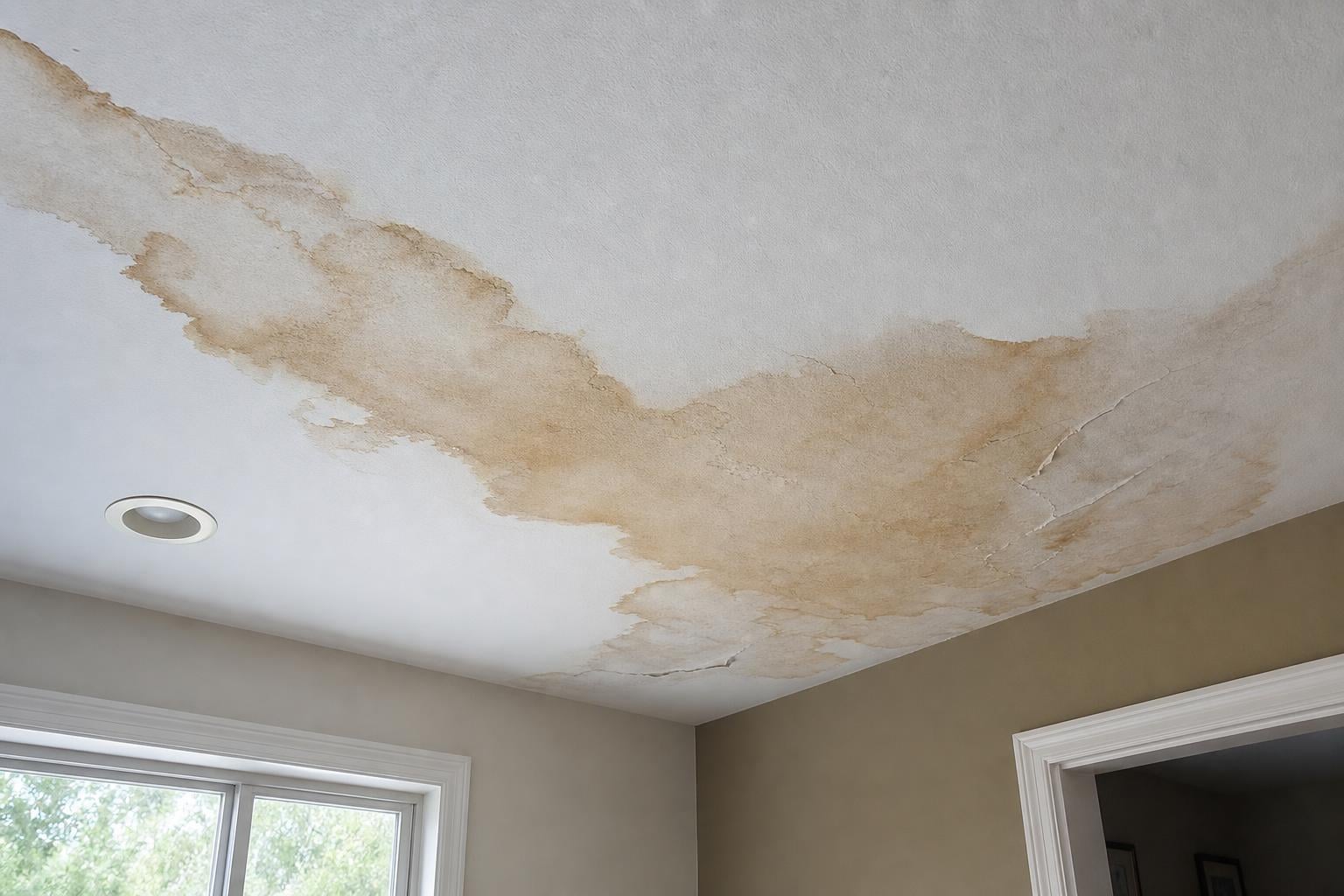
Sign #7: Interior Ceiling Stains, Water Marks, or Active Leaks
The most visible interior sign of upstream roof failure. Also the most commonly misdiagnosed.
Brown or yellow stains on ceilings, water marks bleeding through paint, soft drywall spots, and active drips during rain all signal water intrusion. The challenge is that roof leaks rarely show up directly below the failure point. Water travels along the underside of the decking, down a rafter, across a truss, until it hits a low point and drops to the ceiling.
A stain in the middle of the living room ceiling might come from a failed flashing on the bathroom side of the house. Tracing the source requires either an attic inspection or removing some interior drywall.
Repair vs. replacement decision:
- Localized leak from a specific flashing failure, in an otherwise sound roof: a flashing repair, often under $500.
- Multiple leak points across the roof, in a roof under 15 years old: probably an installation defect; investigate carefully.
- Active leak in a roof over 15 years old, especially combined with other signs from this list: replacement.
Don’t paint over a water stain to make it disappear. The water will return, and now it’ll be hidden until the drywall sags or grows mold.
Sign #8: Damaged Flashing or Soft Metals
Flashing is the metal that seals roof penetrations and edges. When it fails, water gets in even if the shingles look perfect.
Check these locations:
- Drip edge along the eaves and rake. Should be straight, sealed at corners, and not corroded.
- Pipe jacks around plumbing vents. The neoprene boots crack and split after 10 to 15 years.
- Ridge cap. The capped ridge of the roof; look for lifting, missing pieces, or excessive granule loss.
- Valley flashing. Where two roof slopes meet; should be straight, clean, no debris damming.
- Chimney and skylight flashing. The seam between the roof and any vertical element.
- Gutters and downspouts. Hail dents on aluminum or steel gutters are also evidence of storm severity.
Damaged soft metals (gutters, downspouts, vents) are particularly important after a hail event. Even if your shingles look serviceable, hail-dented soft metals establish that an impact event occurred and often support an insurance claim. See “What to Do If You See One or More Signs” below for the decision tree and a link to the full insurance claim walkthrough.
Failed flashing on its own is often a repair, not a replacement. Failed flashing combined with other signs from this list usually means the roof system has reached the end.
Sign #9: Sustained Increase in Energy Bills
This sign is rarely #1 alone, but in combination with one or two others, it confirms a roof system in decline.
A functional roof contributes to the home’s thermal envelope through three things: an intact decking surface that blocks air infiltration, proper attic ventilation that moves heat out in summer and prevents ice damming in winter, and intact shingle field that reflects UV. When any of these fail, the HVAC system has to work harder to maintain interior temperatures.
Look at your last 24 months of energy bills, normalized for weather (most utilities provide month-over-month comparisons that adjust for temperature). A sustained year-over-year increase of 10% or more, without lifestyle changes (new equipment, additions, more occupants), can indicate roof system degradation.
Energy Star roof guidance documents the energy impact of roof condition and ventilation. The savings from replacing an end-of-life roof are typically 5 to 15 percent on cooling costs alone, more in hot climates.
Don’t replace your roof for energy savings alone. Do consider energy bills as a confirming signal when other signs are also present.
Sign #10: Recent Hail Event With Visible Damage
The Rapid City-specific sign that changes the entire decision flow. In a 222-event hail market, a “recent” hail event is the most common reason a homeowner here starts asking whether the roof needs replacement.
After a hail event, look for:
- Soft metal damage. Dents in gutters, downspouts, roof vents, AC unit fins, and pipe jacks. This is the easiest evidence of storm severity and the easiest to document.
- Granule loss patches. Specific to impact zones, accompanied by visible impact craters in the field shingles.
- Fractured or bruised shingles. Press your thumb against the shingle surface. If it gives like a soft fruit, the asphalt mat is compromised.
- Damage to ridge cap, drip edge, and other code-required components.
The decision tree after a hail event:
- Document everything within 24 to 48 hours with photos and notes.
- Get a free written inspection from a local contractor (independent of insurance).
- If the damage rises to a claim level, file the claim. The contractor should attend the adjuster meeting.
- Decide between repair (the rare case where damage is truly localized) and full replacement (most common after a measurable hail event).
If the damage rises to a claim level, the “What to Do If You See One or More Signs” section below includes a link to the full claim walkthrough.
What to Do If You See One or More Signs
The right action depends on how many signs are present and how severe each is.
One sign, low severity. A few curled shingles, a small granule-loss patch, a single repair-grade missing shingle. Get a free written inspection but don’t panic; this is usually a repair, not a replacement.
Two or three signs, moderate severity. Curling plus granule loss, age plus a leak, multiple flashing failures. Schedule a written inspection from a local contractor. Have them quote both repair-grade scope and replacement-grade scope so you can compare.
Three or more signs, or any single severe sign (sagging deck, daylight through decking, active interior leak). Replacement territory. Move directly to vetting contractors and quoting full replacement.
Recent hail event regardless of other signs. File a claim per the hail damage insurance claim guide and have your contractor present at the adjuster meeting.
Once you’ve decided on replacement, two more decisions follow:
- Which contractor. Vetting framework with verification checklist: how to choose a roofing contractor in Rapid City.
- Which material. Standard architectural vs. the Class 4 impact-resistant upgrade decision, which is particularly relevant in this market given hail frequency.
For pricing context on what a replacement actually costs in this market, see the Rapid City 2026 roof replacement cost guide.
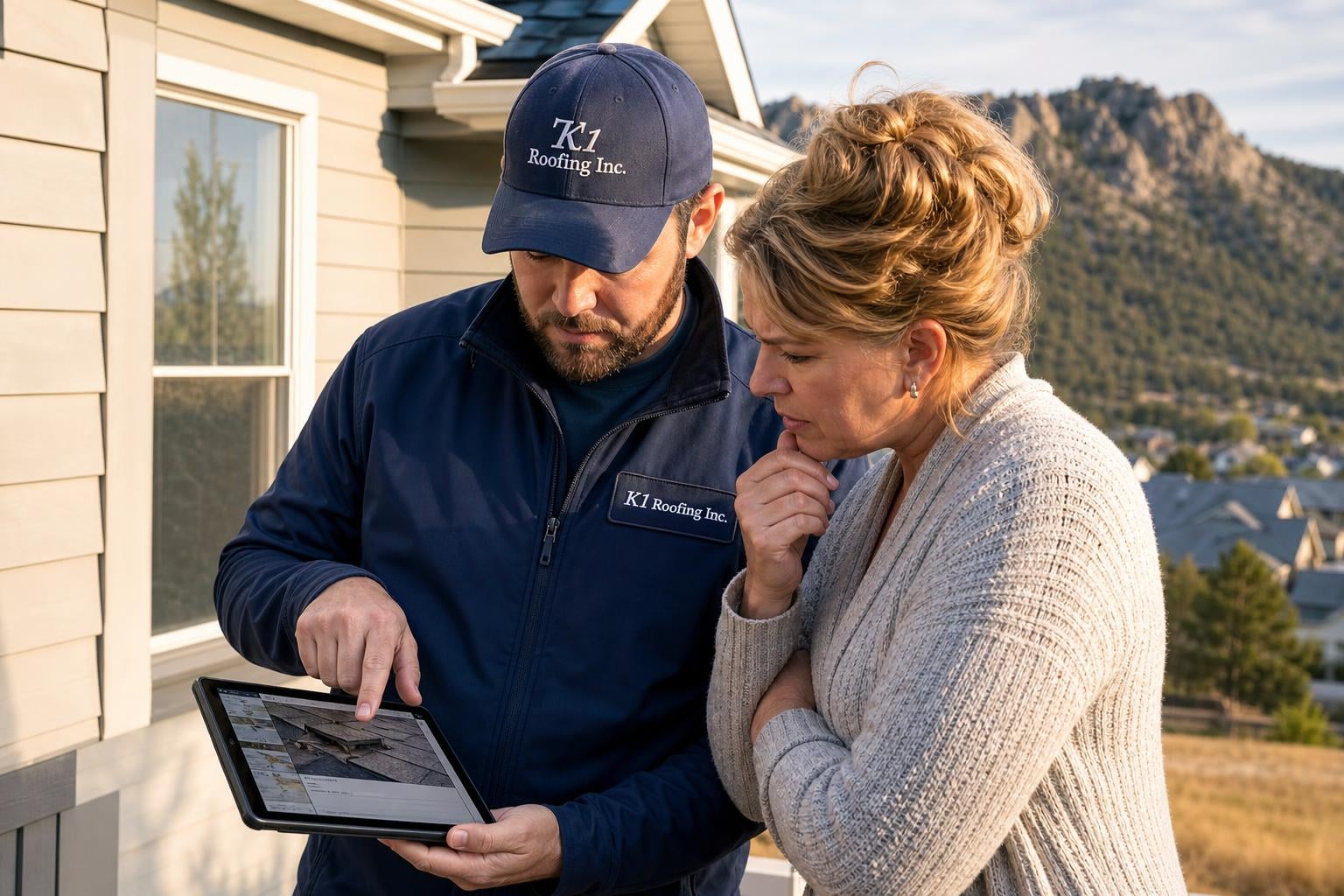
How K1 Roofing Inc. Handles Inspections in Rapid City
K1 provides free written inspections to Rapid City homeowners with no obligation and no commitment to use K1 for the work.
The inspection process: a K1 inspector walks the roof, photographs every observable sign from the list above, checks the attic for interior signals (daylight through decking, water staining on underside of sheathing, insulation condition), documents flashing and soft-metal condition, and produces a written report with photos and a recommendation. The report is yours to keep and to use for insurance claim documentation, contractor comparison quotes, or general homeowner reference.
K1 has been based in Rapid City for over 30 years and is CertainTeed ShingleMaster certified. The written inspection report has been used by hundreds of Rapid City homeowners in insurance claims, contractor comparisons, and replacement decisions. K1 will give you an honest read on whether you actually need replacement or whether a targeted repair will get you another 5 to 10 years.
To schedule a free inspection, contact K1 directly. No pressure, no door-to-door pitch.
Frequently Asked Questions
How long do asphalt roofs last in Rapid City? Standard 3-tab asphalt: 15 to 20 years. Architectural (dimensional) asphalt: 20 to 30 years. Class 4 impact-resistant asphalt: 25 to 35 years. Rapid City’s hail frequency typically reduces the upper end of these ranges by 3 to 5 years compared to lower-hail markets.
Can I inspect my own roof, or should I hire someone? You can do the ground-level inspection (binoculars, soft-metal check, attic daylight check) yourself. Walking the roof safely requires training and equipment; that part should be a professional. A homeowner’s ground-level check catches about 60 to 70 percent of the signs on this list. A roof-walk inspection catches the rest.
How much does a roof inspection cost in Rapid City? A standard roof inspection from a Rapid City contractor typically runs $0 to $250. Many local contractors, including K1 Roofing Inc., offer free written inspections to homeowners with no obligation. Standalone paid inspections from independent inspectors (separate from any contractor doing the work) typically run $150 to $400.
Will my insurance cover a new roof? If the damage is from a covered peril (hail, wind, falling debris) and the policy is current, most South Dakota homeowners insurance policies cover roof replacement, subject to the wind and hail deductible (typically 1 to 2 percent of insured value). Age-driven wear and tear is not covered. The boundary case (recent hail event on an aging roof) is where a contractor’s documented inspection matters most.
What’s the difference between repair and replacement? Repair addresses a localized failure (a single leak, a few missing shingles, a flashing replacement) and typically costs $300 to $2,500. Replacement is a full roof system reinstall and runs $7,500 to $25,000+ in Rapid City depending on size and material. The rough decision rule: if more than 25 percent of the roof shows replacement-grade signs, full replacement is the right call.
How do I know if hail damage is bad enough for a claim? Soft-metal damage (dented gutters, AC fins, roof vents) is the easiest evidence and often supports a claim by itself. Granule loss in impact patterns, fractured shingles, and damage to pipe jacks or drip edge round out the picture. If your contractor’s written inspection identifies any combination of these, a claim is usually warranted. The full claim process is linked from the “What to Do If You See One or More Signs” section above.
![Roof Maintenance Checklist for Rapid City, SD: The Year-Round Homeowner’s Guide [2026]](https://www.k1roofinginc.com/wp-content/uploads/2026/05/k1-roofing-inc-roof-maintenance-rapid-city-sd-featured-400x250.jpeg)
![Commercial Roof Replacement in Rapid City, SD: The Complete Guide for Building Owners [2026]](https://www.k1roofinginc.com/wp-content/uploads/2026/05/k1-roofing-inc-commercial-roof-replacement-rapid-city-sd-featured-400x250.jpeg)
0 Comments