
A roof in Rapid City takes more environmental abuse than the manufacturer’s nominal lifespan accounts for. Interactive Hail Maps documents 222+ historical hail events at or near the city, with 13 in just the past year. Add significant snow load, high-altitude UV exposure, freeze-thaw cycling, and wind events off the Black Hills foothills, and you have a roof that ages faster than the catalog number suggests.
Maintenance buys back lifespan that climate quietly takes away. A roof maintained on a clear annual cycle routinely runs past its rated service life. A roof neglected fails sooner, often during the storm event that would have been survivable with current maintenance.
This guide is the year-round checklist for Rapid City homeowners. Organized by season because the maintenance work changes with the calendar, with monthly quick-checks anyone can do in five minutes, attic and ventilation tasks most homeowners skip, and clear guidance on when a maintenance issue crosses into professional territory.
K1 Roofing Inc. has performed roof inspections and maintenance work across Rapid City for over 30 years. The checklists below reflect what we actually look at on a typical maintenance visit, organized so a homeowner can use them as a printed reference between professional visits.

The Annual Maintenance Cycle for Rapid City Roofs
Maintenance work changes with the seasons because the threats change with the seasons. The annual cycle in this market looks like this:
Spring is the post-winter assessment. Freeze-thaw cycling, ice damming, accumulated snow load, and winter wind have all stressed the roof in ways that often don’t show until temperatures rise and the snow melts off. Spring is when gutter cleanouts catch the granule loss from a hard winter, and when shingle damage from ice damming becomes visible.
Summer is peak hail and severe storm season in Rapid City. Maintenance shifts from cleanup to readiness and response. Documenting the roof’s current condition with photos creates a baseline for any future insurance claim. After any storm event, soft-metal damage and shingle inspection happen within 48 hours.
Fall is the winterizing phase. Final gutter cleanout after leaf drop, tree branch pruning, attic ventilation verification, and any small repairs that won’t survive the freeze-thaw cycle. The work in October and early November protects the roof through the harshest part of the year.
Winter is monitoring rather than active maintenance. Snow load awareness, ice dam visual checks, and attic inspections during snow events catch problems before they become major. Most winter roof work is professional and ground-based; homeowner roof access in snow conditions is dangerous and rarely productive.
The maintenance cycle compounds. Each season’s work prepares the roof for the next. Skipping any one season’s tasks accelerates wear by more than the time saved.
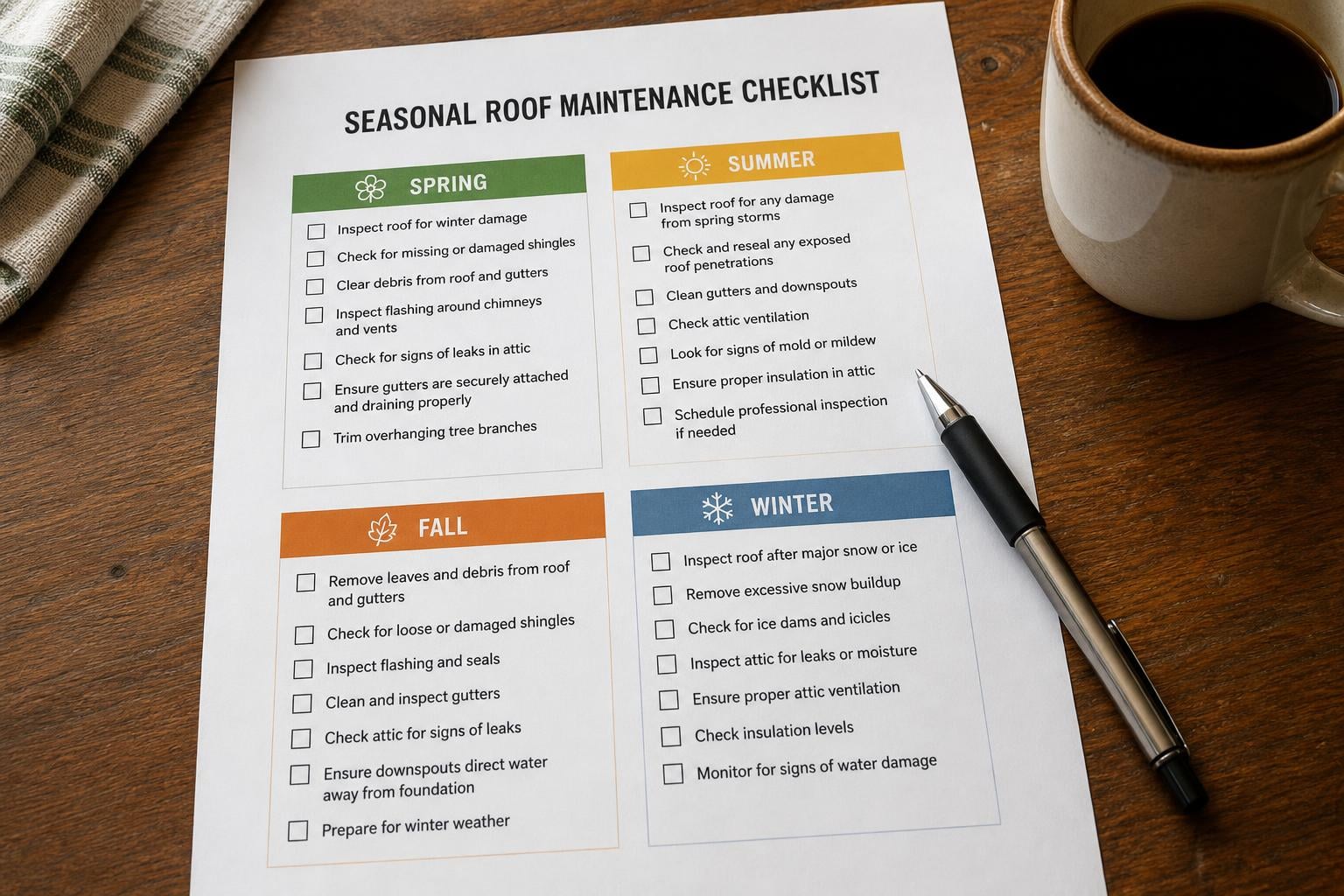
Spring Roof Maintenance Checklist
After winter, schedule the spring inspection in March or April once the snow has cleared and temperatures are reliably above freezing.
Visual ground inspection. Walk the property and look at every roof slope from multiple angles. Binoculars help. Look for visible shingle damage, missing or lifted tabs, sagging anywhere along the ridge or eaves, and any obvious flashing failures.
Gutter cleanout. Remove accumulated leaves, twigs, and ice-melt debris. Flush downspouts with a garden hose to confirm flow. Check that downspout extensions still direct water at least six feet away from the foundation.
Granule accumulation. Look in gutter pans and at downspout splash zones for asphalt granules. Some loss is normal in the first five years of roof life and after storm events; sustained accumulation on a roof over ten years old signals active aging.
Visible shingle damage check. Curled, cupped, or cracked shingles, missing tabs, exposed nails, or any visible bare asphalt mat patches all warrant a closer look.
Soft-metal condition. Gutter dents from accumulated ice or hail, downspout damage, AC condenser fin condition, plumbing vent boot integrity. Soft-metal damage is the easiest evidence of storm severity.
Flashing inspection at penetrations. From the ground, look for any lifted or missing flashing around chimneys, vents, skylights, and roof-to-wall transitions.
Tree branch clearance. Any branches contacting the roof or hanging within three feet should be trimmed before summer storm season.
Attic moisture check. During or right after a rain, check the attic for any water staining, damp insulation, or visible leaks.
Insulation condition. Where attic-accessible, check that insulation hasn’t compressed at the eaves (which would block soffit ventilation airflow).
Annual professional inspection. Schedule a free written inspection from a local contractor if anything from the ground check is concerning or if it’s been more than a year since the last professional inspection. The dedicated “When to Schedule a Professional Inspection” section below covers triggers and what the visit should include.
Summer Roof Maintenance Checklist
Summer maintenance in Rapid City is mostly about readiness and rapid response. The hail season runs roughly May through August, with peak frequency in June and July. The roof needs to be ready before each storm event, and responded-to after each one.
Pre-season baseline documentation. Take photos of the current roof condition (all slopes from the ground), the gutters and downspouts, the AC condenser, and any visible flashing. Date the photos. These become the baseline for any insurance claim after a future storm event.
Insurance policy review. Confirm the policy is current and that the wind and hail deductible structure is understood. Most South Dakota policies use a 1 to 2 percent deductible on the building’s insured value for wind and hail claims.
Soft-metal pre-event documentation. Photograph gutters, downspouts, AC fins, and roof vents from the ground. Post-storm comparison photos make damage easy to identify and document.
Post-storm response checklist (within 24 to 48 hours of any hail or wind event):
- Walk-around photo documentation of soft metals (gutters, downspouts, AC fins, roof vents)
- Look for hail dent patterns on soft metals; these are the easiest claim evidence
- Note any shingle debris on the ground (granules, broken tab pieces, displaced shingles)
- Interior attic check for any new water staining
- Schedule a professional inspection if any damage indicators are present
If post-event damage rises to the claim level, see the hail damage insurance claim guide for the full claim process from documentation through depreciation release.
Tree branch monitoring. Summer growth can put branches back into roof contact even after spring trimming. Check at least once mid-season.
Fall Roof Maintenance Checklist
October and early November are the most important maintenance months of the year in Rapid City. The work in this window protects the roof through the freeze-thaw cycle that does the most cumulative damage.
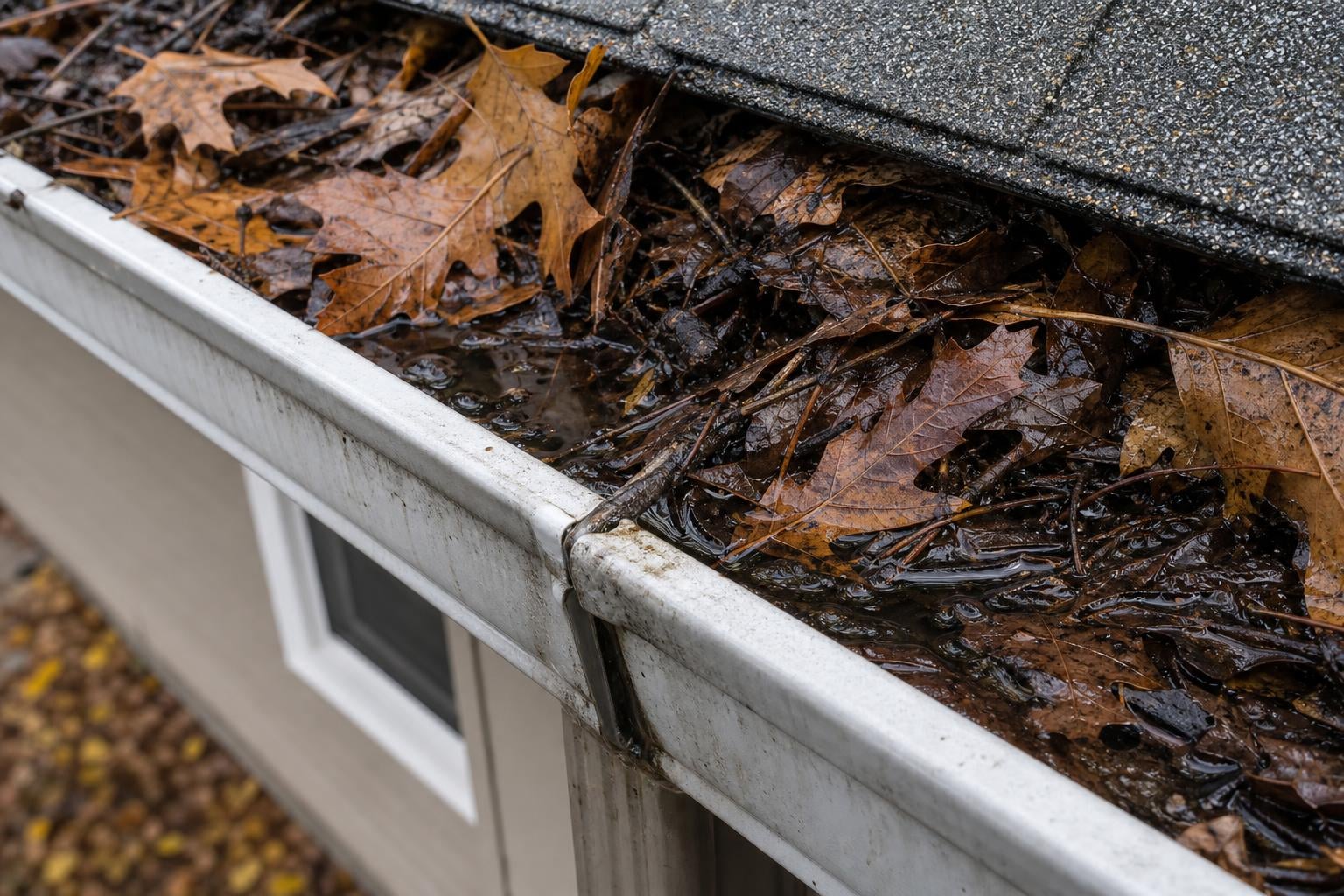
Final gutter cleanout. After leaf drop is complete (typically late October). Remove everything, flush downspouts, confirm flow. A blocked gutter going into winter is a guaranteed ice dam.
Downspout extension and direction. Verify extensions are still in place and still pointing water away from the foundation. Loose or disconnected extensions during winter create freeze-thaw damage at the foundation.
Tree pruning. Final pruning of any branches that overhang the roof or are within three feet of it. Winter ice and snow load make branches fall; branches falling on a roof break shingles.
Pre-winter shingle inspection. Any shingle damage observed during summer or spring inspections that hasn’t been repaired yet needs repair before freeze-thaw season. Damage that survives summer often fails in winter.
Attic ventilation verification. The most-skipped fall task and the most consequential. Confirm soffit vents are clear (not blocked by paint, insulation, or debris), exhaust vents are functional, and air can move from intake to exhaust. Inadequate ventilation is the leading cause of winter ice damming.
Insulation depth check. Especially at the eaves. Insulation needs to extend to the wall plate but not block the ventilation airflow above it. Energy Star insulation guidance describes the depth recommendations for cold climates like the Black Hills, and the National Roofing Contractors Association provides industry-standard maintenance schedules referenced throughout this guide.
Plumbing vent boot inspection. The neoprene boots around plumbing vents crack with age. Cold weather hardens cracked boots and turns small failures into significant winter leaks. Manufacturer guidance from CertainTeed and similar producers recommends inspection at least annually and replacement at the first sign of cracking. Inspect from the ground; replacement requires professional work.
Caulk and sealant inspection. Check sealant at any roof penetrations from the ground or attic. Cracked sealant fails during the freeze-thaw cycle.
Pre-storm documentation. Final photos of roof condition going into winter. Insurance claims for winter wind or ice damage benefit from documented pre-event condition.
Winter Roof Maintenance Checklist
Winter maintenance is mostly monitoring, with a hard safety rule attached.
Snow load monitoring. After major snowfalls, check the visible snow load on the roof. Most asphalt-shingle residential roofs handle the typical Rapid City snow load fine, but back-to-back significant storms can accumulate beyond design capacity. Watch for sagging or unusual snow patterns.
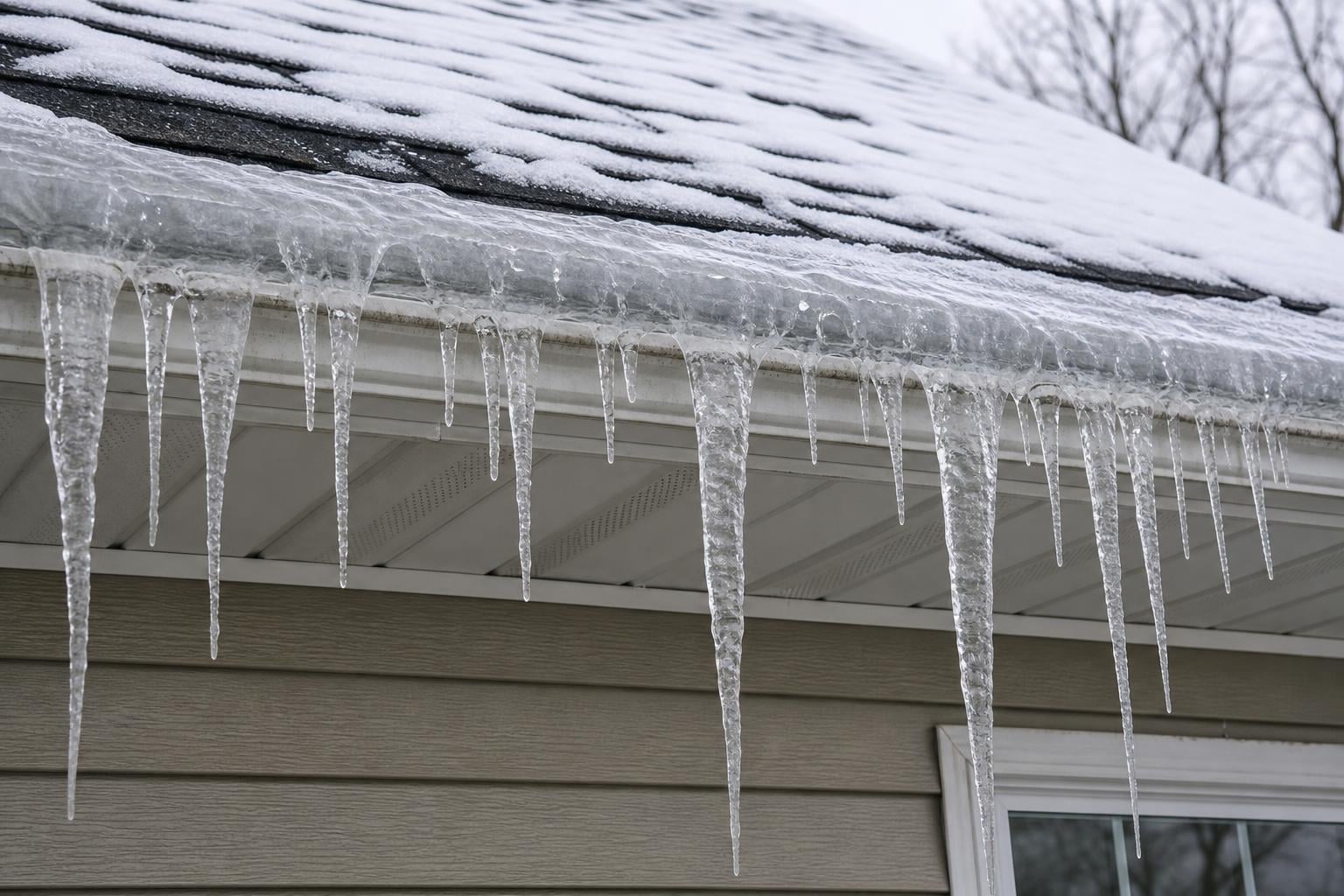
Ice dam visual check. Walk the eaves and look up at the roof line after a snow event. Ice dams form when heat escapes through the roof, melts snow on the upper roof, and the meltwater refreezes at the cold eave edge. The ice ridge that forms can back water up under shingles and cause interior leaks.
Attic inspection during snow events. If a heavy snow is on the roof for a few days, peek into the attic and look for signs of heat loss (uneven snow melt patterns, large icicles, water staining on the decking). These signal ventilation or insulation problems that should be addressed before next winter.
Plumbing vent stack clearance. Heavy snow can bury plumbing vent stacks. A buried vent can cause sewer gas backups and bathroom drain problems. Visual check from the ground after major snowfalls.
Entry area awareness. Ice forming at gutter edges drips and refreezes on walkways below. Salt or sand the affected areas; don’t let foot traffic create a slip hazard.
A safety note that matters more than the checklist
Do not walk on a snow-covered roof. Do not attempt to remove snow from a roof using ladders. Do not climb the roof to chip ice dams.
Most serious winter roof injuries to homeowners come from snow-removal attempts. If snow load is genuinely concerning, a roof rake operated from the ground is the right tool. If snow accumulation is past what a ground-based rake can reach, the right answer is a professional contractor visit, not homeowner heroics. The repair cost from a fall is materially higher than the cost of either a roof rake or a professional snow removal visit.
Monthly Quick Checks Any Homeowner Can Do
Between seasonal checklists, a five-minute monthly check catches problems early.
Binocular survey. Walk the property and look at every roof slope. Note anything different from the prior month.
Ground walk-around. Look for shingle debris, granules, or tab pieces on the ground around the house. New debris between rain events indicates current shedding.
Soft-metal check. Walk past the gutters, downspouts, AC condensers, and ground-accessible roof penetrations. Note any new dents, damage, or unusual condition.
Gutter visual. Glance into any visible gutter sections. New leaf debris is normal seasonally; new asphalt granule accumulation is a flag.
Attic peek. Quick look into the attic with a flashlight, especially after rain or snow events. Any new water staining, damp insulation, or visible leaks goes on the next professional inspection list.
The monthly checks take less time than the typical homeowner spends mowing the lawn once. They catch the gradual problems that the seasonal checklists might miss between visits.
When to Schedule a Professional Inspection
Three triggers for a professional inspection beyond the homeowner-level checks:
Routine schedule. For roofs in years 10 through 20 of service life, annual professional inspection is the right cadence. Newer roofs can be on a biennial schedule. Roofs past year 20 should be inspected at least annually plus after any significant storm event.
Triggered inspection. Any time the homeowner-level checks find damage indicators that aren’t obviously cosmetic. Roof-walk-only conditions like seam separation, flashing failures, or decking soft spots can’t be properly diagnosed from the ground.
Event-driven inspection. After any notable hail or wind event, before listing the home for sale, during property purchase due diligence, or after any roof-impacting event (falling tree branch, lightning strike nearby).
Reputable Rapid City contractors offer free written inspections. The deliverable is a multi-page photo-documented report covering ground walk-around, roof-walk, attic inspection, and soft-metal documentation. For the full inspection scope, what the report should contain, and how to verify the contractor offering it is legitimate (a recurring scam pattern in this market), see the free roof inspection guide.
Soft Metal Maintenance Specific to Hail Markets
Soft metal components (gutters, downspouts, roof vents, AC condenser fins, plumbing vent boots, drip edge) matter more in Rapid City than in markets that don’t see frequent hail. They’re both the easiest-damaged components and the most useful evidence of storm severity for any insurance claim.
Gutters and downspouts. Aluminum or steel gutters dent visibly on impact with hail larger than about 1 inch. The dents persist through subsequent cleanings, which makes them durable evidence of a date-of-loss event. Annual photo documentation of gutter and downspout condition supports any later claim.
Roof vents and AC condenser fins. Both deform on hail contact in patterns that are easy to identify. Box vents, ridge vents, and turbine vents all show impact damage clearly. AC condenser fins flatten visibly. Photograph all of these annually as part of the soft-metal baseline.
Plumbing vent boots. The neoprene collar around each plumbing vent stack ages and cracks over a typical 10 to 15 year lifespan. Hail impact accelerates this. Cracked boots leak water down the inside of the vent into the attic. Inspect every annual visit; replace at the first sign of cracking.
Drip edge. The L-shaped metal edge along the eaves. Hail dents drip edge in patterns that establish event severity. Damaged drip edge also lets wind drive rain under the shingle field, accelerating decking damage.
When any of these soft-metal items show damage that wasn’t there at the prior baseline, the question becomes whether it’s repair-grade or claim-grade. The “When Maintenance Crosses Into Repair or Replacement” section below covers the diagnostic and cross-links the full signs-of-failure guide for deeper context.
Ventilation and Attic Maintenance
The most-skipped maintenance category and one of the most consequential for roof lifespan in Rapid City conditions.
A properly ventilated attic does four things: it removes heat in summer (extending shingle life), removes moisture in winter (preventing decking rot), prevents ice damming (by keeping the roof deck cold), and balances pressure (reducing wind-uplift forces during storms). Energy Star ventilation guidance covers the technical requirements.
A balanced ventilation system has intake vents (typically soffit vents along the eaves) and exhaust vents (typically ridge vents along the peak, or static box vents, or powered attic fans). The intake area and exhaust area need to match within roughly a 1:1 ratio. An unbalanced system either traps moisture (too little intake) or short-circuits airflow (too much exhaust without matching intake).
What to check annually:
- Soffit vent open area, especially looking for paint that’s sealed perforations, insulation pushed against the vent grates, or debris (bird nests, leaves) blocking flow
- Ridge vent or alternative exhaust vent function, no visible damage
- Attic humidity levels (an inexpensive humidity sensor for $15 to $30 is the cheapest diagnostic available)
- Insulation distribution; no compressed areas at the eaves where ventilation should flow
- Bath fan ducts; should exhaust outside the house, not into the attic (a common installation error that causes attic moisture problems)
- No daylight visible through the decking from the underside
A properly balanced ventilation system adds 5 to 10 years to a Rapid City shingle roof’s service life over an unbalanced one. The annual ventilation check is the highest-return maintenance task on this list.
Gutter and Drainage Maintenance
Clogged gutters cause more roof damage than most homeowners realize. The water that should flow away pools at the roof edge instead, backs up under the shingles, and rots the decking from below. The visible part of the damage shows up years after the cause.
Maintenance cadence:
- Spring: full cleanout after the last freeze-thaw cycle and any final snow melt
- Summer: monthly visual check; clean any time debris is visible
- Fall: at least two cleanouts during leaf-drop season (one mid-October, one after the last leaves drop in early November)
- Winter: visual monitoring at gutters for ice dam formation
Downspout extensions should direct water at least six feet away from the foundation. In Rapid City’s freeze-thaw climate, water that pools near the foundation causes structural damage over time. Verify extension placement each season; they shift with mowing, snow plowing, and seasonal activity.
Gutter guards reduce maintenance work but don’t eliminate it. They’re worth considering for second-story or hard-to-access gutters where annual cleanout is dangerous or time-consuming. The guards still need annual inspection because pine needles and small debris pass through most guard systems.
Internal drains on flat or low-slope sections (typical on garage additions, sunrooms, or some architectural features) need separate inspection. Internal drains clog from inside-out and create ponding water that no gutter system addresses.
When Maintenance Crosses Into Repair or Replacement
Maintenance buys time on a sound roof. It doesn’t fix a failing one. The decision point isn’t always obvious from the ground, but several signs make it clear that the roof has aged past what maintenance can address.
Sagging roof deck. Any visible sag along the ridge, eaves, or roof field means structural problems below the shingles. This is replacement territory regardless of how recent the last maintenance was.
Daylight visible through attic decking. During an attic inspection, pinpoint stars of light through the roof boards mean separated, rotted, or damaged decking. Water gets in everywhere light does.
Active interior leaks not resolved by flashing repair. A leak that returns after a flashing repair, or appears in multiple locations after a single event, indicates the overall roof system has reached its end.
Granule loss across more than 15 to 20 percent of the roof field. Once granule loss reaches this threshold, the underlying asphalt mat has limited remaining service life. Maintenance can extend a few more years; replacement is on the horizon.
Multiple shingle damage areas after a single event. A single severe event that produces damage in multiple roof sections suggests the underlying field has aged past the point where the next event will be survivable.
Roof age past the upper end of the rated lifespan. Standard architectural shingles rated for 25 to 30 years that have completed their rated lifespan are ready for replacement even if no individual sign has surfaced yet.
For the full diagnostic on when a roof needs replacement, see 10 signs you need a new roof. For cost context when replacement becomes necessary, see the Rapid City 2026 roof replacement cost guide.
Frequently Asked Questions
How often should I do roof maintenance in Rapid City? The basic cycle is four seasonal checklists per year (spring, summer, fall, winter) plus monthly quick-checks of about five minutes each. Add an annual professional inspection for roofs in years 10 through 20 of service life, or biennial for newer roofs. The cadence is higher than in less hail-prone markets because Rapid City roofs face more cumulative stress per year.
Can I do my own roof maintenance, or should I hire a professional? Most of the seasonal checks (ground walk-around, gutter cleanout, attic inspection, soft-metal documentation) are reasonable homeowner work. The roof-walk inspection portion (walking the actual roof surface) should be a professional, both for safety and because trained inspectors catch conditions that ground-based checks miss. A homeowner ground-level check catches about 60 to 70 percent of the maintenance items; a professional roof-walk catches the rest.
What kind of maintenance does a roof need? Visual inspection from the ground, gutter cleanout in spring and fall, attic inspection for moisture and ventilation, soft-metal documentation, tree branch clearance, sealant and flashing inspection, plumbing vent boot replacement when cracked, and an annual or biennial professional inspection. The seasonal lists above cover each task in detail.
Can roof repairs be done in the winter? Yes, for most repair scopes. Cold-weather installation requires specific shingle handling and adhesive cure considerations, but a competent contractor can complete most repairs year-round in Rapid City when conditions allow. Emergency repairs (active leaks, storm damage) get scheduled immediately regardless of season. Full replacement work is typically scheduled for April through November when conditions are more predictable.
How much does annual roof maintenance cost? Homeowner-performed maintenance is essentially free aside from time. A free professional written inspection from a reputable local contractor is the standard offering. Paid maintenance programs (where a contractor performs the seasonal work on a contract basis) run from a few hundred dollars per year for residential to thousands per year for large commercial buildings. The cost is consistently less than the cost of one preventable failure.
Will roof maintenance extend my roof’s life? Yes, measurably. A roof maintained on a clear annual cycle in Rapid City conditions typically reaches the upper end of its manufacturer-rated lifespan or beyond. A roof neglected commonly fails 5 to 10 years before the rated number. The difference compounds: a $9,500 to $17,500 replacement cost becomes a meaningful return on a few hours of annual maintenance time per year.
![Commercial Roof Replacement in Rapid City, SD: The Complete Guide for Building Owners [2026]](https://www.k1roofinginc.com/wp-content/uploads/2026/05/k1-roofing-inc-commercial-roof-replacement-rapid-city-sd-featured-400x250.jpeg)
![Black Hawk, SD Roofing: K1 Roofing Inc.’s Local Service Guide [2026]](https://www.k1roofinginc.com/wp-content/uploads/2026/05/k1-roofing-inc-black-hawk-sd-roofing-featured-400x250.jpeg)
0 Comments